Search This Blog

Showing posts with label EV. Show all posts

Leaf Mileage Update with 14 Months of Data

It's time for my bi-yearly update on my Nissan Leaf experience. I'm on my second Leaf, having owned a 2012 Leaf SL for two and a half years before trading it in for a 2013 Leaf S. I've written extensively about both Leafs already, so I won't repeat myself too much here. Check out the EV tag for all the gory details. Suffice it to say, I love the Leaf, and after having driven an EV for three and a half years, I can't imagine going back to an ICE car. The Leaf is fun, torque-y, quiet, and oh-so comfortable to drive.

On Range and Battery Degradation


The one major issue with the Leaf is the capacity of the battery, coupled with how long it takes to charge it back up. It has a range of about 85-100 miles on a full charge in the summer, depending on driving conditions, so I'm limited to the city and the immediately surrounding area unless I do careful planning and have a lot of time. Those stars have not yet aligned, but I do enjoy zipping around Madison and coming back home to charge up in my garage. It's the essence of convenience. We have a Prius for the longer and far less frequent trips we need to take beyond a 40 mile radius of our house.

Because EVs are still a new and interesting technology, I keep records of my driving and charging so I can plot things like the change in range over temperature, battery efficiency, and estimated battery degradation over time. To read about the methodology I use, take a look at the two-year update of my 2012 Leaf or the first report of my 2013 Leaf. Basically, I track driving temperature, battery state-of-charge (SOC), mileage, and kWh consumed at the wall outlet. I always trickle charge off of a 110V outlet through a P4460 Kill-A-Watt power meter so I know exactly how much electricity I've used to charge the car.

Since the main question to answer about the Leaf is what kind of range it gets, I use my data to estimate the range I could get on every charge. I scale up the miles I drove to what it would be if I charged the battery to 100% and drove the car until the battery died. This is assuming the SOC is linear over the entire range, even though that doesn't seem to be exactly true. In my experience a 1% change in SOC will take you farther when the battery is mostly discharged than when it is mostly charged, but I don't have a good way to account for this so I assume it's linear. Then I plot these estimated ranges against the average temperature for each discharge cycle, and I get the following plot for 14 months worth of data:


This plot is interactive, so you can hover on points to get details and zoom in by selecting an area with the mouse. Clearly, the range has a significant dependence on temperature, with a range as low as 42 miles at sub-zero temperatures and as high as 110 miles in perfect summer weather. I very rarely use the air conditioner or heater, so range would be reduced from this data if climate control was used on especially hot or cold days. In fact, the outlier at 86°F and 78 miles of range was a day when I drove the family 53 miles with the air conditioner running to keep them comfortable. It was also a trip that was about half freeway driving at 65 mph, which further reduced the range. (For a great set of charts on the Leaf's range dependence on driving speed, check out the range charts at MyNissanLeaf.com.)

I split the data between the first 8 months and the last 6 months so we can see how the range has changed over time. Trend lines are shown for both sets of data, and the few outliers—one in 2014H2 and two in 2015H1—were ignored when calculating the trend lines. The two lines are practically indistinguishable at the warm end of the temperature range, and those points are further apart in time, taking place in the summer in 2014 and the beginning of summer in 2015. The 2014H2 range at the low temperatures is actually lower than the 2015H1 range even though the points at that end of the graph happened closer in time and the lower range points happened earlier, likely because it was slightly colder at the end of 2014 than at the beginning of 2015. Overall, it appears that the battery has had a negligible amount of degradation in the past 14 months.

I do what I can to keep my battery as healthy as possible, since a healthy battery will have a longer range over a longer period of time. To take care of the battery, I generally follow these guidelines:
  • Charge to 80%.
  • Do not charge if SOC is at 80% or above.
  • Avoid hitting the low battery warning at 17%, the very low battery warning at 8%, and turtle mode at the end of charge.
  • No DC Quick Charging.
  • Reduce the number of charging cycles by not charging every night.
  • Store the battery at a lower SOC, if possible, by not charging every night and delaying a charge if I know I'm not driving the next day.
  • Limit the depth of discharge (DOD) by charging before a trip that would take the SOC below 20%.
Limiting the number of charging cycles and limiting the DOD are in direct conflict, so it's a balancing act. I'm not sure what the best trade-off is between charging cycles and DOD, but I tend to err on the side of shallower DOD. My average DOD over the last 14 months has been 51%, meaning I normally drive until around 30% SOC and then charge up to 80%. I've gone as deep as 71% and as shallow as 17%. The following histogram shows the distribution of DOD cycles that my Leaf has had:

Leaf DOD Distribution Chart

On Energy Efficiency


That leaves the Leaf's energy efficiency left to look at. I measure the energy used at the wall outlet as well as keep a record of the on-board energy efficiency meter for each month of driving, so I can plot those over time. I can also calculate the charging efficiency from these two energy efficiency numbers, and all three series are plotted in the next chart:

Leaf Energy Efficiency bar graph

You can see that all three efficiencies got worse during the cold months of winter and have now recovered with the Leaf's efficiency meter reporting well over 5 miles/kWh as the weather has warmed up. I even set a new monthly record of 5.5 miles/kWh this month, as measured by the Leaf or 4.5 miles/kWh from the Kill-A-Watt meter at the wall. Charging efficiency for trickle charging is also up over 80% with the warmer weather. I'm not sure what the oscillating behavior of the charging efficiency was about last year, but it seems to have gone away for now. It possibly has to do with the coarseness of the Leaf's efficiency values.

I'm getting fairly good efficiency numbers with the type of commute that I have through the city of Madison, and so far I've used 1,740 kWh of electricity to drive 6,644 miles. Since I pay $0.18 per kWh, that's $313.20 total, or $0.047 per mile that I pay to charge my car. That's the equivalent of paying $1.41 per gallon of gas for a 30mpg car or $0.94 per gallon for a 20mpg car to drive the same distance. That's pretty nice even with the higher than national average price I pay for electricity (to support wind power).

Future EVs


The Leaf has been a great first EV experience for me, and I'm excited to see what the future holds for electric cars. So far the Nissan Leaf, Chevy Volt, and Tesla Model S have been the only practical EVs widely available, and they each serve different markets. The Leaf, being a pure EV with limited range, is a city commuter car. The Volt, with its gas generator, is the PHEV for people that need a full-range vehicle. The Model S is the EV for those lucky individuals that have $100k+ to burn on a car. Now the BMW i3 has entered the ring as well, and it's a combination of the other three cars—the electric range of the Leaf, the gas generator of the Volt, and some of the luxury of the Model S at a little higher price than the Leaf or the Volt.

These EVs have made some significant advances over the past four years, and soon it looks like there will be some bigger leaps forward. Rumors are surfacing that Nissan will increase battery capacity in the Leaf 25% for the 2016 model year, and double it for the 2017 model year. Chevy is getting ready to release the all-electric Bolt with a 200 mile range, and they're increasing the battery capacity of the Volt as well. Tesla is getting close to releasing the Model X SUV, and the mass-market Model 3 with a 200-mile range and a $35k base price will follow, hopefully in 2018. The next couple years are going to be interesting for EVs with at least three affordable cars becoming available with a 200-mile driving range. Hopefully other manufacturers will get in the game, too, and we'll have even more options to choose from. That kind of range could be a game-changer for EVs. I can't wait.

Better Mileage Data with the 2013 Nissan Leaf

I've now had a 2013 Nissan Leaf for nearly 8 months, and temperatures here in Madison, WI have gone below zero, so I have a nice amount of data to share on this newer model. The 2013 Leaf S replaced the 2012 Leaf SL I had previously, and it includes a state-of-charge (SOC) percentage display on the dash that was lacking in the older models. This SOC reading is a major improvement to the unreliable GOM (Guess-O-Meter, or miles-to-fully-discharged meter) that I used before in my data collection.

I haven't invested in any other kind of meter for measuring the Leaf's battery state because I wanted to treat the car more like a normal driver would. Measuring internal battery messages off of the car's CANbus was decidedly outside of normal driver behavior. I did purchase a P4460 Kill-A-Watt power meter for measuring the amount of electricity that is consumed by charging the car. The on-board energy efficiency meter doesn't take charging losses into account, and I wanted to know exactly how much electricity the car is using. I'll report on those numbers as well.

Before getting into the numbers, I will say that I still greatly enjoy driving the Leaf. The 80kW electric motor is nice and torque-y, with zippy performance for around town and pleasing acceleration when jumping on the freeway. The power is especially evident when scaling steep hills, as the Leaf tears up inclines as if they aren't even there. And the ride is always smooth and super quiet.

The handling so far this winter has been pretty good as well. The traction and stability control and the ABS all work when they need to, and the car's low center of gravity from the under-carriage mounted battery helps quite a bit, too. The one thing that could be improved in snow is the stock tires. They don't have the best traction, and the other safety systems have to compensate when the tires slip. I'll probably finish out the winter with them since the tread is still pretty new, but next winter I'm going to switch to snow tires. We're using winter tires on the Prius this year, and they've had an insignificant effect on mileage, so I expect the benefits of using them on the Leaf to greatly outweigh the minor range hit that I'll take.

Data Collection Methodology


Collecting data on the Leaf was fairly straightforward. After every charging cycle, I would log the date, the charge percentage, and the accumulated kWh on the Kill-A-Watt meter. I nearly always charge to 80% unless I know I'm going on a long drive the next day. I was under the impression that the lower charge level was better for the battery. Although, I now hear that new Leafs will no longer have the 80% setting option. I'm not sure if that's because Nissan is trying to avoid consumer confusion, or because there really is no negative impact to the battery when charging to 100%. It seems reasonable that the latter could be true as long as the battery isn't charged until it gets below 80% SOC. The use case for a car battery is much different than for a laptop battery, where keeping it plugged in wears out the battery because it continually charges to 100% during use.

After each drive I keep a record of the %SOC, the odometer reading, and the outside temperature as reported on the dash. I won't charge every night if I don't need to, and I often bring the battery down to 10-20% before charging. I don't normally go below that since there isn't much useful range left for me to get to work and back again at that point. I have a new job with a shorter 16-mile round-trip commute through town instead of my old 23-mile round-trip commute on the beltline, so I can now go three or four days between charges in the summer. There's probably a trade-off between less depth-of-charge and less charging cycles for better battery life, but I have no idea where the optimal point is so I go for less charging cycles.

Once I have a good amount of data logged, I transfer it to Google Sheets to calculate range, average temperature, and miles/kWh. Estimating range is much easier with the %SOC numbers because all I have to do is subtract start and end odometer readings and divide by the %SOC used for those miles. I'm assuming that the miles/%SOC is linear for this calculation, but I'm not likely to push the limit to squeeze a few extra miles out of the battery at the end of the range, so assuming the same miles/%SOC over the entire range is acceptable to me. I'm still getting a reasonable estimate of range over many charging cycles.

I calculate an average temperature for each charging cycle by taking the average of temperatures for each driving segment weighted by miles driven in each segment. Temperature has a big effect on range, so getting an accurate value amidst big Midwest temperature swings is important. I'm sure that the temperature during charging also has an effect, but I don't know how I would estimate this effect without monitoring temperature during every charging cycle. I'm not set up to do that so I ignore that effect. Besides, charging temperature is heavily correlated with driving temperature, even though the Leaf is always charging in a garage. The garage is unheated so it's always a milder form of the outside environment.

The miles/kWh are calculated two ways. The car's measure of efficiency is recorded from the dash, and I let the meter run a measurement for a month before recording the value and resetting the meter. I also calculate the wall-to-wheels efficiency by dividing the miles travelled in a month by the kWh usage for that month from the Kill-A-Watt meter. I can then divide the wall-to-wheels value by the battery-to-wheels value to get an estimate of charging efficiency.

That's how I collect and massage the data, so let's take a look at what we've got.

What is the Real Range of a Leaf?


That is the most common question I get when I talk with people about the Leaf, and for good reason. Everyone knows EV ranges are limited right now, and the answer is it depends, of course. One thing it depends greatly on is temperature. Here's how much my Leaf's range changed with temperature in the last 8 months:


It's an interactive chart so you can zoom and get info on specific points with the mouse. Clearly, temperature is the dominant effect, and the range is cut in half over the temperature range. While I was getting about 100 miles of range at 75°F, I am getting only about 50 miles at 0°F. Luckily, I don't have to drive far to work. This plot does include a mix of stop-and-go city driving and free-way driving at around 55 mph. I did take the Leaf on the interstate once at 65 mph, but only for a short while and it doesn't noticeably show in the chart.

Two features to note in this chart are the outlier at 86°F and the wider variation in driving range at both ends of the temperature range, especially below 40°F. Regarding the outlier, this point happened to be a trip I took with the rest of the family to a high school graduation party. It was hot and raining so there was extra road resistance and I ran the A/C to keep everyone comfortable. The combination of extra weight, road resistance, and constant A/C resulted in about a 20% drop in range, which doesn't surprise me.

The wider variation at the high temperature range is likely due to there being more data points over a wider range of driving conditions. Then as the temperature dropped in the fall, the points followed a more linear curve into the colder temperatures of winter.

The main reason for the wide variation at cold temperatures is probably due to a number of reasons. Depending on temperature and humidity, I have to use the defroster more or less and sometimes I use the heated seats (although the seats don't seem to impact range much). If there's snow on the roads, that adds resistance and lowers efficiency. Lower temperatures happen to coincide with less daylight and inclement weather, so I use the headlights more and usage varies a bit more depending on the weather. Since I have normal headlights instead of the LED headlights that come as an option, they use more battery power. Finally, traffic varies more in the winter, and if I'm stuck in traffic, that amplifies all of the other losses, resulting in even more variation at cold temperatures.

Despite all of these variations, I was amazed at how much more linear this data is than the data from my 2012 Leaf, using the GOM to estimate range instead of the %SOC on the 2013 Leaf. Here is the scatter plot of the 2012 Leaf data for comparison:

Scatter plot of 2012 Leaf estimated range vs. temperature

This plot has many more data points, but it still looks like it has much more variation than the 2013 Leaf data does. It will also be interesting to see if the 2013 Leaf maintains its approximately 100 mile range next summer, since that seems to be better than the 2012 Leaf was while the lower temperature ranges are roughly equivalent. The regular headlights of the 2013 Leaf could be part of the reason for it not being more efficient than the 2012 Leaf in the winter.

Overall, I'm quite happy with the data I'm getting from the 2013 Leaf. I'm a bit less enthusiastic about the steep drop in range over temperature, but when I compare it to our Prius, the change in efficiency is not all that different. We normally get 55+ mpg from the Prius in the summer, but on one of those bitter cold winter days I only got 28 mpg. The big difference with the Prius is that its normal range is about 500 miles on a full tank. Cutting that range in half still leaves plenty of range to get where you need to go. When EVs have 300+ mile ranges on a charge, it won't be as big of a deal when the range drops in the winter.

How Much Does it Cost to Charge?


This is the second most common question I get about the Leaf. So far I've driven 3,811 miles and measured 983 kWh of electricity use from the wall. With an electricity usage rate of $0.18/kWh, it's cost me $177 to drive that 3,811 miles. If I compare that to a car that gets 30 mpg, it would be like paying $1.39 for a gallon of gas. The price of gas has dropped quite a bit, but it hasn't dropped quite that far. Also, paying for electricity has the advantage of being a relatively fixed rate. It doesn't change nearly as much as the price of gas, and gas prices have been much higher in the past and probably will be higher in the future.

Beyond the absolute cost of charging the Leaf, it's interesting to look at the charging efficiency. I always charge with the 110V trickle charger (except once) since I have plenty of time at night, and I've never had a problem finishing a charge before driving the next day. Using a Kill-A-Watt power meter at the wall outlet and the on-board energy efficiency meter in the Leaf, I can measure the wall-to-wheels and battery-to-wheels efficiency, respectively. After doing this for 8 months and grouping the data by month, I get the following results (September and October are combined because of a long vacation where the Leaf sat idle):

Leaf Energy Efficiency bar graph

The charging efficiency is easily calculated by dividing the wall-to-wheels efficiency by the battery-to-wheels efficiency, and it hovers around 80%, dropping slightly to 75% in November. I'm not quite sure why that happened. Another behavior that this chart shows is that the drop in energy efficiency does not fully explain the drop in range at lower temperatures. If that were the case, then the Leaf should have a range of about 80 miles in the winter, but I was averaging more like 60 miles for the last couple months. This discrepancy must mean that both the energy efficiency and the battery capacity drops with temperature. While the usable battery capacity is 19-20 kWh in the summer, it dropped to 15 kWh or less in the cold, accounting for about half of the range loss.

Because of the range loss in the cold, the Leaf is definitely not the best car choice for everyone. If you live in a cold climate, you have to be careful to make sure you have enough range to get where you need to go or have a backup plan when the temperature drops too far. My commute is plenty short, so it works quite well for me. I love driving around in a smooth, fast, quiet car. I look forward to driving it everyday, and I couldn't imagine going back to an ICE car willingly. Once battery capacity catches up with our needs, we'll be looking to get out of our Prius and into a longer-range EV. In the mean time, I'll be enjoying the Leaf and will continue to collect data to see how it performs over time. It will be interesting to see what next summer brings.

My First 220V Public Charging Experience

Nissan Leaf charging port

I've always charged my Nissan Leaf using the 110V trickle charger that comes with the car. Recently, through my own forgetfulness, I needed to use a 220V public charging station, and my impression of the experience is mixed. I didn't have any problems with finding and using a charging station. That was easy. But I was surprised by what it did to my range.

Before getting too far into it, let's back up to the night before. I was coming home from work, and pulled into the driveway with 20% charge left. I remember thinking that I had to plug the car in because it was unlikely that I would make it to work and back the next day on that little charge. Then I remembered that my wife and kids were away at violin camp (those lucky ducks), and I was the only one left to bring the mail in so I better do that. That first thought about charging flitted right out of my brain. I parked the car, walked down to get the mail, and walked right back up into the house, leaving the Leaf unplugged in the garage.

I kid you not, my first thought the next morning when I woke up was OH CRAP! I forgot to plug my car in! Why is it that you vividly remember important things when it's far too late to do anything about them? Anyway, I rushed out to the garage in my skivvies to check, and sure enough, the car was distinctly missing its umbilical cord.

As I was getting ready for the day, I ran over options in my head. I could attempt to make it to work and back on the charge left, but it would be tight. The Leaf tends to lose charge more slowly at the end of the range, and I could drive more conservatively and probably be fine. But I would be much more comfortable if I could charge up at work. Luckily, I had gotten a couple of ChargePoint cards with my new Leaf. I had never made the effort to sign up with ChargePoint when I had my previous Leaf, but the salesman tipped me off that MG&E was doing a study of EV owners so I could charge for free if I signed up for their program.

I checked on the ChargePoint.com site, and there were a couple charging stations in a parking garage within easy walking distance of the office. It was time to give public charging a try. It's not that I was against it; I just never had the need to use it before and charging at home is so much more convenient. After checking the website one more time to make sure the charging stations were available, I was on my way.

Finding the stations was easy, but the first one I found was located in a handicapped parking zone. I'm not sure EV drivers and handicapped drivers are that well correlated right now, so I'm a bit confused on the utility of that setup. Looking a little further up the ramp, I found another station. There was a Ford Fusion PHEV plugged into the 110V trickle charger, but the space next to it was free. I pulled in, plugged in the 220V cord, and swiped my card. The car started charging without a hitch. Cool beans, I thought. I'll come back during lunch and see how it's doing.

When I came back, the car had finished charging to 80%. The meter showed that it had charged for exactly 4 hours. With the 3.3 kW charger, that would have been 13.2 kWh of charge, which is a bit low for charging from 12% to 80% based on my charging log. Normally I get about 4.2% per kWh of charging, which means it should have taken 16.2 kWh to charge that much. Still, I hadn't expected the car to be done charging when I went to check on it, and I didn't think much of the discrepancy. I was quite pleased as I drove over to my normal parking spot by the office and finished out the afternoon at work.

On my drive home I noticed the charge level dropping faster than normal. After only three miles it had dropped 6%. That was a little disconcerting. By the time I had run some errands and returned home, it had dropped 23% in 15 miles. Somewhere in the neighborhood of 15-18% would have been much more typical for that distance. Indeed, I had driven the same route under the same conditions a couple days earlier and only dropped 16% charge on that trip. What was going on?

I decided to not charge that night and see what happened on my drive the next day. I still had 57% charge remaining, so I wasn't too worried that I would get stranded. As it turns out, the battery behaved pretty normally from then on, and I drove 40 miles on 38% of charge before charging up again with my trickle charger. I drove the same 15 mile route again at 80% charge, and this time dropped 20%—not great, but better. By the next charge things were totally back to normal.

So what the heck happened to my battery in the 80% to 55% range of charge with the 220V Level 2 charger? I'd heard other Leaf owners claim that they lose charge faster at the top end of the range, and as they reached 50% and below, they could go more miles on the same decrease in charge. I always wondered why I didn't see something similar with my Leaf. My charge level has always decreased very linearly with miles until the very end, even the few times that I charged to 100%.

Here's what I think happens with the different chargers and the battery. You know how when you pour a beer from a tap with perfect pressure, you can easily fill the glass all the way up, getting beer within an eighth of an inch of the rim and a small amount of head? It's beautiful. The charge from a trickle charger is like that. The charge is flowing into the battery at a slow enough rate that the Lithium ions can be efficiently packed within the chemical structure of the electrodes, resulting in a nice, strongly charged battery over its full range.

Now think about what happens to a beer tap that has too much pressure in the lines. The beer pours too fast and gets churned up in the tap and the glass, resulting in lots of foamy beer with more empty space and less tasty beverage. The L2 charger is more like this because it's dumping charge into the battery much faster. The ions get churned up more, the battery heats up more, and the resulting charge is not as strong as with the trickle charger. You end up with a lot of head in your battery.

Of course, this is not really what's happening in the battery. The electrochemical process is a bit more complicated than that. It's an analogy, but a useful one. The charge at the top end of the range is definitely not as strong, or the battery is not as efficient in that range from an L2 charge. However you want to think about it, it's pretty clear that for the same energy usage, initially the charge level goes down faster when the battery is charged at 220V.

Having the public charging station available was great in this situation, but I wouldn't rely on L2 charging stations for daily charging needs. If you want to get the most out of your battery, you should be charging with the trickle charger whenever you can. It's better for your battery's health, and you'll go farther on a charge. I know I'll be sticking with the trickle charger for my Leaf. Happy charging!

Why Electric Vehicles Will Finally Beat The ICE Car

I recently read yet another article from someone who does not believe that electric vehicles (EVs) will have any significant impact on the auto industry or help much in reducing CO2 emissions. He proceeded to walk out several weak arguments to support his theory. While I will go into these arguments in more detail, I want to make it clear that I'm not responding to this article specifically. I'm addressing the misguided ideas in general. I believe these misconceptions are fairly widely held by people who think of electric cars as toys that have no hope of becoming a real force in the market, and they justify their reasoning with outdated information that has become irrelevant or has long since been proven flat out wrong.

The article in question was written by Jason Perlow as a response to Matthew Inman (a.k.a. The Oatmeal) and his awesome, over-the-top review of his new Tesla Model S. I take Mr. Perlow at his word when he says that he is concerned about climate change and wants to see the most efficient and practical technologies adopted to alleviate the dangerous trends we're seeing in the environment. But then he trots out these tired old saws:
However, what I think has been lost in all this positivism and blind futurism about EVs and Tesla is how unrealistic electric cars still are for the average family.

Not only that, but they do not fundamentally solve the problems of moving to more sustainable energy sources; nor are they particularly "greener" or less fossil-powered than their gasoline, diesel, or even hybrid cousins.
These statements get at the three main criticisms of EVs: high cost, short range, and dirty energy source. Assuming that the current state of these issues for EVs will remain constant, or even improve only slowly, betrays a serious lack of vision and judgement. People who think like this must think, "Well, EVs have been widely available for two full years now. Why can't they go for 600 miles on a charge, pull electrons out of the sky, drive autonomously, sprout wings, and fly? Oh, and they shouldn't cost more than a used, stripped down Honda Civic."

Seriously, EVs have only had significant research and development investments in the last decade or so, yet they are advancing amazingly quickly. ICE cars, on the other hand, have had over a century of enormous capital investment, and they're struggling to achieve minor performance and efficiency gains. Let's take a look at the cost and range issues, because they're related, before tackling the more involved issue of how green EVs are and will be.

Choose Low Cost or Long Range, For Now


EVs are primarily electronic devices that happen to have some wheels to make them move. ICE cars are primarily mechanical devices that happen to have electronic components for sensing and control. Historically, electronics drop in price much more rapidly than mechanical devices, so it stands to reason that EVs will quickly drop in price relative to ICE cars.

Batteries are the single most expensive component of an EV, so if battery costs fall, the price of the car will fall with it. As battery production volumes increase (think Gigafactories) and raw material sourcing improves, prices are sure to come down significantly. In fact, over the 2010-2012 time frame, battery prices fell by 40%, and that trend looks to be continuing or even accelerating.

Batteries are also increasing in energy density by about 7% per year, or doubling about every 10 years, so they're getting smaller and lighter in addition to getting cheaper. Nissan is already talking about that trend with a Leaf that has double the current range slated for 2017. They also claim that battery energy density is improving much faster than anticipated, so range improvements will likely be coming much faster than their six year model cycle.

One way to think about EVs is that they are like computers. Back in the 80s and 90s, computers were expensive because they were advancing rapidly and companies were focusing on grabbing performance gains. Most reasonably powerful computers sat in the $2000-$3000 range. By the 00s, you could get more than enough power for most uses, and prices started to drop precipitously. Now you can get a ridiculously powerful computer for less than $1000, and even $500 will get you more computer than you need in most cases.

EVs are solidly in the first phase right now where they can add range while keeping the price constant, or they can drop the price while keeping the range constant if there's enough of a market for the lower range cars. Once they achieve adequate range at a low price, it's going to look like the 00s all over again. The other main components of EVs - the motors, inverters, chargers, and regenerative brakes - will also contribute to falling costs as they are standardized and mass-produced.

That's not to say that all EVs are expensive even now. Already there are many different options serving different customers. Want a mid-sized car for tooling around town or as a second commuter car? There's the Nissan Leaf S for less than $20k. Want more range for longer trips, but most trips are less than 40 miles? There's the Chevy Volt for about $28k. Want more luxury and possibly extended range for longer trips? There's the BMW i3 for about $38k. Want to go balls to the walls and price is irrelevant? There's the Tesla Model S for $65k-$110k+. (All prices are after the federal tax credit.)

(Update: I, of course, forgot to mention the gas savings. The EPA estimates savings of about $9,000 over five years versus the average (23mpg) gasoline car. This assumes 45% city and 55% highway driving at 15,000 miles per year. Your mileage will vary substantially, but you can customize the estimate on fueleconomy.gov to see what you would save. Regardless, it's significant, and makes the already affordable EVs look even better.)

There are more options out there, but those seem to be the big four right now. New models are coming out every year to fill different market holes and increase consumer choice. And then there's Tesla. Tesla is disrupting the industry, and other manufacturers are forced to respond. If Tesla does the same thing to the average consumer market that they're doing now to the luxury market, they will dominate most of the auto market within the next 5-10 years. Nissan, GM, and BMW are racing to get EVs ready in time to compete with Tesla's mass market EV (formerly the Model E) before it's too late. The other auto manufacturers are taking notice, but if they don't step up soon, they're going to miss out big time.

When people say that EVs have a huge technical hurdle to overcome, and will only become viable if they can solve these problems, they are being disingenuous at best. These technical problems are being solved as we speak. EVs are already better than ICE cars in the luxury segment and as an everyday commuter car. Within a few years EVs will meet or beat ICE cars on most metrics. Within a decade they will be far superior to ICE cars in nearly all cases. The detractors are choosing to ignore these obvious trends because they can't seem to envision a world where everyone is driving around in fun, quiet electric cars.

How Green Is An EV, Really?


EVs have to be charged up with electricity, and that electricity comes from a variety of sources. Mr. Perlow presents a graph produced by the US Energy Information Administration (EIA) that predicts rising electricity generation from natural gas and renewables, while the use of nuclear and coal electricity generation stays flat.
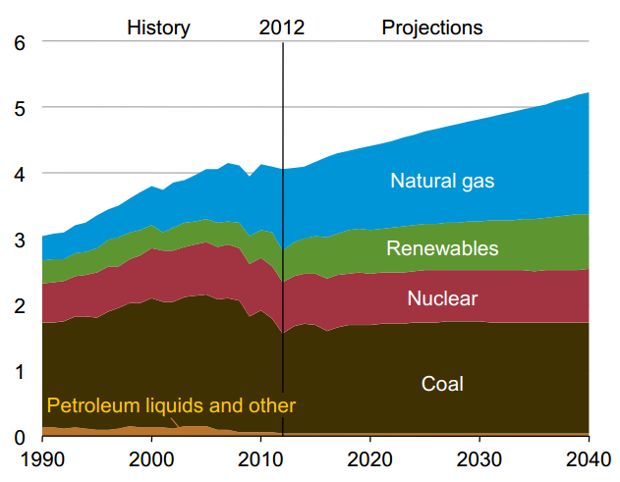
Projected electricity generation by fuel, 1990-2040 (in trillions of kilowatt-hours). Source: United States Energy Information Administration, May 2014

The interesting thing about the graph is the sharp drop in coal use for the five years leading up to the last year of data in 2012. Why won't that continue? What is causing the prediction to run flat instead of plummeting to zero by 2025? What would this chart have looked like in 2005 at coal's peak? That last question is easy to answer. Here's a chart from the EIA produced ten years ago.

Electricity generation by fuel, 2004 and 2030 (billion kilowatthours)

This chart shows coal-based electricity generation heading well north of 3 trillion kWh by 2030, while the latest prediction has coal staying below 2 trillion kWh through 2040! What happened? Natural gas mostly, but also renewables. The prediction from 2004 is clearly wildly off-base even ten years out, and totally useless for a 25 year outlook. Also consider that the energy sector is in a state of flux now, and things are going to change drastically over the next few decades. Using any predictions right now to make claims about the state of electricity generation in 25 years is probably ill-advised.

Long-term predictions are largely irrelevant, but one thing seems to be obvious. Nuclear power isn't progressing much, yet Mr. Perlow promotes nuclear electricity generation as the option to focus on. The problems with nuclear power are numerous. Nuclear plants are extremely capital intensive and take a long time to develop. Nuclear fuel is a very limited resource that's hard to get and expensive to refine. Maintenance of nuclear plants is expensive, and critical to public safety.

These are all difficult problems, but the most difficult problems to overcome are the sociopolitical ones. No one wants a new nuclear power plant in their back yard. Period. Need I mention Fukushima? Then there's the problem of guarding the nuclear fuel before, during, and after using it. The government absolutely does not want terrorists getting their hands on uranium and plutonium, even if it's not weapons grade material.

Why not spend all of that time and capital building solar fields, wind farms, geothermal plants, and other renewable energy sources for much less risk? They scale much better than nuclear, and especially with solar (another electronic device), the more they scale, the cheaper they get. Due to their variable nature, renewable energy sources are also a great compliment to EVs because EVs provide part of the storage solution for when the sun isn't shining or the wind isn't blowing. Then there's Solar Freakin' Roadways, solar panels that can replace pavement and are perfectly aligned with EVs.

The point of all of this is that no matter which way the energy sector goes in the future, it's most likely not going to be coal, so all EVs, including all those currently in use, will automatically get cleaner as the electric grid gets cleaner. And for those people that install solar panels or wind turbines, their emissions will drop to zero. If we manage to eliminate coal and natural gas as electricity generation fuel sources at some point, then all EVs will have zero emissions. How's that for potential?

But that's the future; what about now? Mr. Perlow makes a curious claim about diesel cars, his personal favorite gasoline alternative: "While they aren't emissions-free by any means, modern diesel car engines also produce less CO2 when compared with gasoline engines." I'm not sure why people think this is true. I keep hearing it, but I've never seen any proof.

Sure, modern diesel cars are cleaner than they used to be, but when I look at fueleconomy.gov, my main source for comparing cars for fuel efficiency and emissions, for every fuel efficient diesel car there's a gasoline car with equivalent fuel efficiency and lower emissions. That doesn't even include hybrid cars, which are significantly better than diesels, and EVs, which blow them all out of the water.

Since you can only compare up to four cars on fueleconomy.gov, here's a table with a selection of the best 2014 EVs, hybrids, diesels, and high efficiency gasoline cars in both the luxury and mid-sized segments:


Luxury Car
Combined
MPG/MPGe
Total Emissions (g/mile)
Tesla Model S-85 kWh (NY)
89
110
Tesla Model S-85 kWh (US average)
89
250
Tesla Model S-85 kWh (WI)
89
310
Lexus GS 450h (Hybrid)
31
357
Mercedes-Benz E250 (Diesel)
33
392
Audi A6 (Gasoline)
28
396
BMW 535d (Diesel)
30
430
Mid-sized Car
Combined
MPG/MPGe
Total Emissions (g/mile)
Nissan Leaf (NY)
114
80
Nissan Leaf (US average)
114
200
Nissan Leaf (WI)
114
240
Chevy Volt (NY)
37/98
170
Chevy Volt (US average)
37/98
250
Chevy Volt (WI)
37/98
290
Toyota Prius (Hybrid)
50
222
Toyota Corolla (Gasoline)
35
317
VW Passat (Diesel)
35
368

I loosely sorted them by lower emissions first, but kept each model of EV together. The EVs have three entries corresponding to different electricity generation fuel mixes in different areas of the country. I picked a best-case scenario of New York state, the US average, and my home state of Wisconsin, which has a fairly dirty fuel mix of mostly coal-fired plants. If you charge your EV with solar panels or purchase renewable energy offsets (as I do), then your total emissions would be zero.

Notice how the diesel car emissions are worse than all of the other cars, even if the mileage is better. Both the Mercedes-Benz E250 and the BMW 535d get better mileage than the Audi A6, but the A6 emissions are essentially the same as the E250 and 8% lower than the 535d. The Lexus hybrid's emissions are 10% lower than the E250, and the Tesla's emissions are nearly one quarter those of the E250 on New York state electricity.

On the mid-sized car side, the Toyota Corolla has 14% lower emissions than the VW Passat with equivalent fuel efficiency, and the Prius just crushes the Passat with 40% lower emissions. The Prius competes rather well with the Nissan Leaf and Chevy Volt over the average mix of US electricity, but it's no contest if the EV and PHEV are in clean electricity areas. The Leaf has nearly three times less emissions than the Prius and 4.6 times less emissions than the Passat!

I really don't understand why people want to buy diesel cars. They're more expensive, and the fuel is more expensive than an equivalent gasoline car. There's a wide selection of gasoline and hybrid cars that are just as, if not much more, fuel efficient than diesel cars so there's no fuel cost savings there. It's more difficult to find fuel because not every gas station offers diesel. And they still have higher emissions than many gasoline, most hybrid, and all electric cars. Diesel is not a viable alternative clean fuel. EVs and PHEVs are already hitting dramatically lower emission levels, so there is no need for an interim technology anyway.

The Real Reason EVs Will Dominate


The main arguments against electric cars are range, cost, and dirty electricity source, but these are all largely overblown or only issues right now. EVs are not standing still; not by a long shot. Every year they are improving significantly with no end in sight. Detractors that point to the state of EVs this year or last year and try to extrapolate that into claims about how they'll never work out are either being short-sighted or naive. The disadvantages are just engineering problems to be solved, while the advantages are fundamental, and the advantages of EVs - much better comfort and convenience - are things with which no ICE car can compete. 

People love comfort and convenience. Most of the choices we make that are not directly related to basic needs center around maximizing comfort and convenience. EVs go a long way to improving both of those things. EVs are super quiet with silky smooth acceleration and are really fun to drive. Then when you're done with your comfortable drive, you can pull into your garage, plug in your car, and you'll be all juiced up for the next day. That means no runs to the gas station ever again. Oh, and there's also the convenience of nearly zero maintenance. That's why EVs will finally beat the ICE car. I say good riddance.