Programming is like any other craft, whether that be engineering or woodworking or auto repair. Every craft has its tools that must be learned and maintained in order to do beautiful work and make wonderful things. In the craft of programming, one of the main tools we work with is programming languages. The more languages we know and the better we know them, the more versatile and valuable we can be as programmers and the better our solutions become. Fortunately, it's extremely easy to find websites to help you practice with programming problems and build up your skills with the languages you already know or bring you up to speed on languages you're trying to learn. They're so easy to find that it may be a bit overwhelming to pick one and settle in to actually work on some problems. Here are some of my favorite (free) sites—and why I like them—to help simplify that decision.
Showing posts with label Scheme. Show all posts
Showing posts with label Scheme. Show all posts
Tech Books I Will Read Again
I have read a crap-ton of technical books, mostly on software, but some either more general or hardware related so I felt the need to generalize the genre to "technical" books. If you've been following my blog for the last year, you'll agree that especially recently, my reading rate has been arguably excessive. I'm reaching a point where I'd like to slow down and focus on some other things in my free time, but I'm also reflecting on all of the great and not-so-great tech books I've read. One of the defining factors in whether I think a tech book is excellent versus merely good is if I have the urge to read it again. (For anyone wondering, there is no distinction needed for the bad tech books.) This feeling might happen right after I finish it, or even while I'm reading it the first time. It also might take a while to percolate and rise back to the surface as a book I want to go back to. The bottom line is, a mark of a great tech book is that it's worth revisiting, so what follows is a list of tech books I've read that I thought were so great that I'm going to read them again.
Tech Book Face Off: How to Design Programs Vs. Structure and Interpretation of Computer Programs
After reading and reviewing dozens of books on programming, software development, and computer science, I've finally come to a couple of books that I should have read a long time ago. I'm not quite sure why I didn't read these two books earlier. Distractions abound, and I always had something else I wanted to read first. I still wanted to see what they had to offer, so here I am reading How to Design Programs by Matthias Felleisen, Robert Bruce Findler, Matthew Flatt, and Shriram Krishnamurthi and Structure and Interpretation of Computer Programs by Harold Abelson, Gerald Jay Sussman, and Julie Sussman. As I understand it, these books are meant to introduce new students to programming so not reading them until now will probably make it difficult to accurately critique them from the perspective of the target audience. I'm still going to give it a try.
 | VS. | 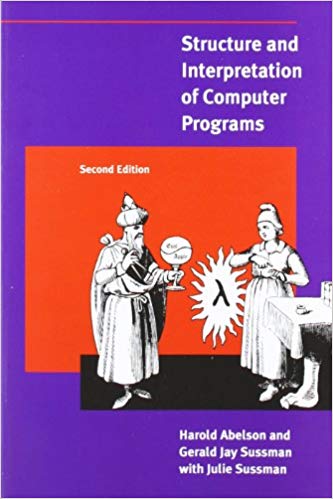 |
Tech Book Face Off: The Seasoned Schemer Vs. The Reasoned Schemer
Years ago I was led to the Schemer books by some of Steve Yegge's blog posts. It's been over two years since I've read The Little Schemer, but I enjoyed it so much that I always planned to read the sequel, The Seasoned Schemer. I recently made the time to do just that, along with working through another Schemer book, The Reasoned Schemer, that's not so much a continuation of the other two Schemer books as it is a tangential book written in the same endearing style as the others. Daniel P. Friedman and Matthias Felleisen wrote The Seasoned Schemer in the style of a Socratic dialogue, but in a much more whimsical way. A host of authors, including Daniel P. Friedman again, as well as William E. Byrd, Oleg Kiselyov, and Jason Hemann put together the questions, answers, and Scheme-based reasoning language used in The Reasoned Schemer. The real question is, are these two books as good as the original?
 | VS. |  |
What I've Learned From Programming Languages
I just finished up learning about fourteen new programming languages, and while my head may still be spinning, I've been struck by one thing about learning new languages. Every single new language I learn teaches me something new and valuable about programming. Some languages reveal many new things because they happen to be the first language I've learned based on a new programming paradigm, and other languages may expose only one or two new ideas because they overlap quite a lot with languages I already know. Every language has shown me at least one new thing, though, so I thought I'd take a look back and pick out one thing learned from each language I've encountered. Some of these languages I've used extensively and others I've barely scratched the surface, so I may miss some great insights in the languages less well-known to me, but that's okay. There's still plenty to reflect on.

Learning Without Understanding
It's funny what you can do without knowing what you're doing. For instance, I started programming in Lisp over a decade ago without even knowing it. I realized this, when a few months ago, I started learning the Scheme dialect of Lisp and things felt oddly familiar. I had seen function names like car, cdr, and cons before, along with all of those parentheses. It turns out that I had already learned another dialect of Lisp called SKILL, and I had had no idea what I was learning at the time. I wonder if I would have learned more and gained a wider understanding of the development environment I was working in had I understood what I was doing those many years ago.
Tech Book Face Off: The C Programming Language Vs. The Little Schemer
I decided it was time to take a look at two of the oldest books on my tech book list, the famed The C Programming Language from 1988 by Brian Kernighan and Dennis Ritchie (a.k.a K&R) and the not quite as old The Little Schemer from 1995 by Daniel Friedman and Mathias Felleisen. In the world of programming, these books are ancient, but I still hoped to gain something from reading them because new (or at least forgotten) insights can often be gleaned from old books.
I have been programming in C and C++ for nearly two decades now, so picking up a few insights was my main goal with K&R. I didn't expect to learn a ton of new stuff about the language since it's such a small language and I've been using it for so long. As for The Little Schemer, I have heard so many good things about this book and the Scheme programming language (a dialect of Lisp) that I was excited to see what it was all about. I was surprised by both books, and probably not in ways that you would expect. Let's take a look at both books in more detail.
I have been programming in C and C++ for nearly two decades now, so picking up a few insights was my main goal with K&R. I didn't expect to learn a ton of new stuff about the language since it's such a small language and I've been using it for so long. As for The Little Schemer, I have heard so many good things about this book and the Scheme programming language (a dialect of Lisp) that I was excited to see what it was all about. I was surprised by both books, and probably not in ways that you would expect. Let's take a look at both books in more detail.
 | VS. |  |
Subscribe to:
Posts (Atom)