Last week I explored how reducing friction could increase choice, thereby actually increasing friction in the end, giving us a paradox of choice because too much choice is overwhelming. Reducing friction can have another undesirable side-effect. When things get easier, it increases the amount of waste that's generated in a system.
This outcome may seem counterintuitive because in physical systems friction generates waste as heat, and reducing friction makes the system more efficient because less energy is lost in the form of heat. More insubstantial systems like the economy or civilization as a whole don't work exactly like physical systems, though. When you look at how our civilization has progressed, we seem to generate more and more waste as we reduce the amount of friction in our lives. Will this trend continue, and how will we deal with it?
Showing posts with label Energy. Show all posts
Showing posts with label Energy. Show all posts
Finding Optimal Friction
In the last twenty years, the Internet and mobile devices have reduced or eliminated friction in numerous industries. Obviously the communication sector has been dramatically affected, including telecom, music, television, and publishing industries. Now anyone with an Internet connection can put their stuff up on-line for the world to see, and new players like Netflix have been able to challenge the big networks for our prime time hours.
The Internet has leveled the playing field across the communication industries, and it's now easier than ever for competing producers to get their products in front of customers. That's one way to look at the concept of friction in markets, from the perspective of producers. Another way to look at friction is from the consumer's perspective, and that friction has been dramatically reduced, as well. From having all of the world's information literally at your fingertips to being able to buy nearly anything at the click of a button and having it shipped to your door, the Internet has gone a long way in removing friction from consumers' lives.
However, not all industries or aspects of our lives have been affected equally by the Internet, and sectors like energy and transportation still have a lot of friction that could be reduced with the right advances in technology. Energy production and automobiles are ripe for a technological revolution.
Reducing friction isn't the be-all and end-all for making our lives easier, though. Reducing friction comes with its own cost, and I think we sometimes forget how high that cost can be. We can end up wasting more time and energy in a frictionless environment due to distraction and an overwhelming amount of choice. Finding the right balance means recognizing where too much friction is wasting our energy so that we can target those inefficiencies and realizing where too little friction is wasting our time so that we can avoid those time sinks. It's a constant struggle as we push forward with technology.
The Internet has leveled the playing field across the communication industries, and it's now easier than ever for competing producers to get their products in front of customers. That's one way to look at the concept of friction in markets, from the perspective of producers. Another way to look at friction is from the consumer's perspective, and that friction has been dramatically reduced, as well. From having all of the world's information literally at your fingertips to being able to buy nearly anything at the click of a button and having it shipped to your door, the Internet has gone a long way in removing friction from consumers' lives.
However, not all industries or aspects of our lives have been affected equally by the Internet, and sectors like energy and transportation still have a lot of friction that could be reduced with the right advances in technology. Energy production and automobiles are ripe for a technological revolution.
Reducing friction isn't the be-all and end-all for making our lives easier, though. Reducing friction comes with its own cost, and I think we sometimes forget how high that cost can be. We can end up wasting more time and energy in a frictionless environment due to distraction and an overwhelming amount of choice. Finding the right balance means recognizing where too much friction is wasting our energy so that we can target those inefficiencies and realizing where too little friction is wasting our time so that we can avoid those time sinks. It's a constant struggle as we push forward with technology.
Driving On Sunshine
Every once in a while you come across an idea that jolts your brain and gives you a glimpse of what the future could be like. My wife read about one such idea the other day that has the potential to completely change the transportation sector and the energy sector, for that matter. It would be a revolutionary change, not an evolutionary change, and I can only begin to imagine the possibilities. It all starts with paving the nation's roads with solar panels.

It sounds crazy, right? But Scott and Julie Brushaw at Solar Roadways have a working prototype of a solar panel that can withstand the especially harsh conditions of highway road surfaces and produce electricity from the sun at the same time. Solar Roadways have a lot more information on their FAQ, for anyone who's interested, but here's a summary from their Indiegogo campaign:
It's the kind of distributed application of renewable energy that I've been thinking would come about but just couldn't visualize myself - a new application that fundamentally changes our relationship with energy the way the internet changed the way we communicate. The breadth of possibilities is astonishing, but I would like to focus on one in particular - the interaction of such a roadway with EVs. First, what could such a future look like if every road was paved in solar panels driven on with EVs? And second, what is a feasible way to get there?
If we ignore how we would achieve such a thing, and imagine for a moment that all of our roads were already filled with solar panels, what would driving be like? ICE cars would certainly be a thing of the past, but EVs would be much different than they are today as well. For one, if cars could get the energy they needed from the road, they wouldn't need much on-board energy storage. (Not to mention how freaking cool it would be to drive on your energy source, powered by the sun.) Batteries could be much smaller than they are now, instead of needing to get larger to increase the car's range.
Take a Nissan Leaf, for example, with its 24 kWh battery pack. It has about 80 miles of range, but how much battery capacity would the car really need if it got nearly all of its energy from the road through inductive charging? Certainly not more than a quarter of its current range would be necessary, but maybe 10 miles or even 5 miles would be sufficient. As the battery capacity drops, so would its weight, reducing the load on the drive motor and making it more efficient.
The battery would also probably be more advanced and thus higher energy density, reducing the weight even further. So would a 1-2 kWh battery be sufficient? A car with such a small battery could charge much faster than today's EVs, and you probably wouldn't have to ever plug it in anyway because it would charge from the road. Of course, it would also be much less expensive as well. Considering that the Leaf's battery likely costs well north of $10,000, such a car would probably cost half of what the Leaf does now.
EVs would not only get energy from the road, but information as well because the panels all have communicating microprocessors in them. It's a smart road, and it would make autonomous vehicles much easier to develop and coordinate than they are now. If every car could communicate with the road and each other, accidents could be all but eliminated, traffic congestion could be substantially reduced, and cars could form highly efficient drafting trains to further reduce energy usage. These are all benefits that could be achieved by autonomous vehicles without a smart road, but with a smart road, the number of sensors needed on the car could be dramatically reduced and the amount and quality of information used to make decisions could be much better.
A self-driving car would also provide the obvious benefit of relieving the driver to do other more productive or enjoyable things. So, a solar road could enable cars that never have to be charged or fueled up, automatically take you safely where you want to go, and cost less than today's dumb cars do. Can I have one now, please?
Obviously, we're not going to go from today's asphalt roads and ICE cars to smart solar roads and autonomous EVs overnight, but that's the beauty of this type of technology. Solar panels could easily be added to sections of road, piecemeal at first, and gradually more extensively as the production ramped up and the idea caught on.
Even without inductive charging EVs or autonomous vehicles to take advantage of the most advanced features of the panels, the road would immediately provide substantial benefits in power generation, and all of the other things mentioned above. Installing solar roads would have zero impact on the ICE cars that most people have, and there's no reason why new ICE cars couldn't also take advantage of the sensors and communication abilities of the solar roads and add autonomous features as well. People that needed ICE cars for their range to get between sparsely paneled sections of road wouldn't have to switch to EVs prematurely.
As solar roads became more connected and pervasive, people could move to EVs and the EVs could begin reducing their battery capacity. The transition could be completely incremental, without requiring any drastic shifts in production or forced decommissioning of ICE vehicles. Although, I would imagine when a certain area reached a critical mass of solar roads and autonomous EVs, all of a sudden everyone would switch over, like everyone did with smart phones and flat panel TVs. The benefits would be too great to ignore.
On the production side, factories could be built in a distributed way so that panels could be sourced more locally to where they're needed, creating thousands of new jobs across the country. If all of the roads were to be repaved with solar panels, a lot of factories would be needed to produce all of those panels for quite a long time, and some number of factories would be needed indefinitely for replacing damaged panels and paving new roads. Building that kind of manufacturing infrastructure would give a huge lift to our economy, likely for decades to come.
The possibilities are fascinating to think about. The Interstate Highway System cost about $500 billion in 2014 dollars, took 35 years to build, and completely revolutionized transportation and our economy. A project to pave the nation's roads in smart solar panels would be even larger in scale and would have an even greater impact on our economy's health and vibrancy. Do we have the political and financial will to undertake such an awesome endeavor? I hope so. It will be a total game changer.
It sounds crazy, right? But Scott and Julie Brushaw at Solar Roadways have a working prototype of a solar panel that can withstand the especially harsh conditions of highway road surfaces and produce electricity from the sun at the same time. Solar Roadways have a lot more information on their FAQ, for anyone who's interested, but here's a summary from their Indiegogo campaign:
Solar Roadways is a modular paving system of solar panels that can withstand the heaviest of trucks (250,000 pounds). These Solar Road Panels can be installed on roads, parking lots, driveways, sidewalks, bike paths, playgrounds... literally any surface under the sun. They pay for themselves primarily through the generation of electricity, which can power homes and businesses connected via driveways and parking lots. A nationwide system could produce more clean renewable energy than a country uses as a whole (http://solarroadways.com/numbers.shtml). They have many other features as well, including: heating elements to stay snow/ice free, LEDs to make road lines and signage, and attached Cable Corridor to store and treat stormwater and provide a "home" for power and data cables. EVs will be able to charge with energy from the sun (instead of fossil fuels) from parking lots and driveways and after a roadway system is in place, mutual induction technology will allow for charging while driving.The panels are quite feature-rich, making the national highway system a nearly complete, integrated infrastructure that combines transportation, power generation and distribution, communication networks, and water storage. I would imagine that the panels could also be upgraded to add new features as they're thought up and developed.
It's the kind of distributed application of renewable energy that I've been thinking would come about but just couldn't visualize myself - a new application that fundamentally changes our relationship with energy the way the internet changed the way we communicate. The breadth of possibilities is astonishing, but I would like to focus on one in particular - the interaction of such a roadway with EVs. First, what could such a future look like if every road was paved in solar panels driven on with EVs? And second, what is a feasible way to get there?
A World Paved in Solar Panels
If we ignore how we would achieve such a thing, and imagine for a moment that all of our roads were already filled with solar panels, what would driving be like? ICE cars would certainly be a thing of the past, but EVs would be much different than they are today as well. For one, if cars could get the energy they needed from the road, they wouldn't need much on-board energy storage. (Not to mention how freaking cool it would be to drive on your energy source, powered by the sun.) Batteries could be much smaller than they are now, instead of needing to get larger to increase the car's range.
Take a Nissan Leaf, for example, with its 24 kWh battery pack. It has about 80 miles of range, but how much battery capacity would the car really need if it got nearly all of its energy from the road through inductive charging? Certainly not more than a quarter of its current range would be necessary, but maybe 10 miles or even 5 miles would be sufficient. As the battery capacity drops, so would its weight, reducing the load on the drive motor and making it more efficient.
The battery would also probably be more advanced and thus higher energy density, reducing the weight even further. So would a 1-2 kWh battery be sufficient? A car with such a small battery could charge much faster than today's EVs, and you probably wouldn't have to ever plug it in anyway because it would charge from the road. Of course, it would also be much less expensive as well. Considering that the Leaf's battery likely costs well north of $10,000, such a car would probably cost half of what the Leaf does now.
EVs would not only get energy from the road, but information as well because the panels all have communicating microprocessors in them. It's a smart road, and it would make autonomous vehicles much easier to develop and coordinate than they are now. If every car could communicate with the road and each other, accidents could be all but eliminated, traffic congestion could be substantially reduced, and cars could form highly efficient drafting trains to further reduce energy usage. These are all benefits that could be achieved by autonomous vehicles without a smart road, but with a smart road, the number of sensors needed on the car could be dramatically reduced and the amount and quality of information used to make decisions could be much better.
A self-driving car would also provide the obvious benefit of relieving the driver to do other more productive or enjoyable things. So, a solar road could enable cars that never have to be charged or fueled up, automatically take you safely where you want to go, and cost less than today's dumb cars do. Can I have one now, please?
Getting There From Here
Obviously, we're not going to go from today's asphalt roads and ICE cars to smart solar roads and autonomous EVs overnight, but that's the beauty of this type of technology. Solar panels could easily be added to sections of road, piecemeal at first, and gradually more extensively as the production ramped up and the idea caught on.
Even without inductive charging EVs or autonomous vehicles to take advantage of the most advanced features of the panels, the road would immediately provide substantial benefits in power generation, and all of the other things mentioned above. Installing solar roads would have zero impact on the ICE cars that most people have, and there's no reason why new ICE cars couldn't also take advantage of the sensors and communication abilities of the solar roads and add autonomous features as well. People that needed ICE cars for their range to get between sparsely paneled sections of road wouldn't have to switch to EVs prematurely.
As solar roads became more connected and pervasive, people could move to EVs and the EVs could begin reducing their battery capacity. The transition could be completely incremental, without requiring any drastic shifts in production or forced decommissioning of ICE vehicles. Although, I would imagine when a certain area reached a critical mass of solar roads and autonomous EVs, all of a sudden everyone would switch over, like everyone did with smart phones and flat panel TVs. The benefits would be too great to ignore.
On the production side, factories could be built in a distributed way so that panels could be sourced more locally to where they're needed, creating thousands of new jobs across the country. If all of the roads were to be repaved with solar panels, a lot of factories would be needed to produce all of those panels for quite a long time, and some number of factories would be needed indefinitely for replacing damaged panels and paving new roads. Building that kind of manufacturing infrastructure would give a huge lift to our economy, likely for decades to come.
The possibilities are fascinating to think about. The Interstate Highway System cost about $500 billion in 2014 dollars, took 35 years to build, and completely revolutionized transportation and our economy. A project to pave the nation's roads in smart solar panels would be even larger in scale and would have an even greater impact on our economy's health and vibrancy. Do we have the political and financial will to undertake such an awesome endeavor? I hope so. It will be a total game changer.
The Digital Revolution Will Change Our Relationship with Energy
The Industrial Revolution lasted for about 80 years, from 1760 to 1840, and brought us disruptive innovations in energy with steam power and communication with the telegraph. The Technical Revolution, from 1860 to 1920, did the same with the diesel engine and electricity generation for energy and the telephone and radio for communication. These technologies were a major driving force for productivity and the economy, and they changed the very nature of how we live our lives.
Now we are in the midst of The Digital Revolution where the widespread use of computers and the internet are continuously changing how we interact with other people. Yet, we haven't seen a major disruption in how we produce and use energy in a way similar to that characterized by the last two technological revolutions. That change is surely set to come, and the way that the internet has changed our relationship with each other could show the way that our relationship with energy will change.
It seems that some people thought from my last article that I was portraying myself as an expert in the future of EVs. Let me be completely clear that I am not an expert in that, nor in this article on the future of energy. My expertise comes solely from what I read about the subject, and my desire to wrestle with complex ideas and combine trends together to speculate about the future. If at any point it seems like I don't know what I'm talking about, that's because I don't, but quite possibly, neither do you. The future of technology is notoriously hard to predict, yet it is still great fun to do, so I like to keep an open mind.
In speculating about future technology, I try to look at general trends without looking specifically at what is possible today. Doing that may carry me past the edge of possibility, but that is where real disruptive advances in technology happen. The naysayers are always right at first, but they are only right until someone who's likely not paying attention comes along and proves them wrong. That's when the impossible becomes possible. So, here's fair warning that there is hand-waving optimism ahead. If that offends you, stop reading now, but if you enjoy dreaming about eternal possibilities, then let's have some fun.
The amount of solar energy that hits the Earth's surface is simply astounding. Let's do some quick and dirty calculations to get an idea of how much energy we're talking about here. Since these will be incredibly large numbers, we'll use petawatt-hours (PWh) as the energy unit of measure. That's a watt-hour with 15 zeros behind it.
We can approximate the surface of the Earth as a disc that the sun's rays hit. The area of that disc multiplied by the solar constant of 1,366 watts per square meter gives the amount of solar radiation that hits the Earth's surface in an instant. The radius of the Earth is about 6,371 km, giving a disc area of 127.5 * 10^12 square meters and an energy flux of 174 PW. Multiply this by 24 hours to get the amount of solar energy reaching Earth's surface in a day - about 4,180 PWh.
As a point of comparison, the total energy used by commercial energy sources from 1880 to 2000 is about 4,806 PWh. Let that sink in for a moment. The Earth is bathed in nearly as much energy from the sun in one day as the world used in 120 years. We might want to think about capturing some of that energy. Of course, we can't capture anywhere near all of that solar energy. Much of it is absorbed by the oceans, plants need it for photosynthesis, and the Earth needs a fair amount for warmth to support life. But the World's energy usage in 2010 was about 150 PWh, or about 0.41 PWh per day. That's rounding error compared to the amount of solar energy we're getting in a day.
If we were to capture some of this energy using solar PV panels, it's difficult to think about how much we could reasonably capture starting from all that is available, so let's come at it from the other direction of how much we need to satisfy our energy needs. Limiting things a bit further, let's look at the energy needs of the U.S. Here is a great chart of the U.S. energy usage in 2012, from Lawrence Livermore National Labs (click to enlarge):

For our purposes, we'll convert Quads to PWh, with 1 Quad equaling 0.293 PWh. That means the U.S. used 27.9 PWh of energy in 2012, mostly coming from natural gas, coal, and petroleum. But look at how much was wasted in electricity generation and transportation. Electricity generation was only 32.5% efficient and transportation was abysmal at 21% efficient. Most of that energy was expelled as heat, as well as a significant amount of wasted electricity because utilities need to generate extra supply for demand spikes.
Solar (and wind) is inherently different than fossil fuels because the energy is there regardless of whether we use it or not. Any amount of energy we can capture for useful purposes can be thought of as energy that was reclaimed from the vast amount of unused renewable energy that's available. And once solar power plants are installed, the maintenance and operating costs can be much lower than coal power plants or oil refineries because the energy source does not need to be constantly dug out of the ground and consumed by the plant; it's already freely available without any extra effort to keep generating electricity.
Because of the way that residential, commercial, and industrial sectors use electricity that already uses raw resources, as well as their relatively high efficiency compared to generation and transportation, let's ignore them and focus on the amount of energy consumed from electricity generation and transportation that does useful work. If we were to replace all of that coal and oil (and natural gas, nuclear, etc) with solar energy, we would need to generate 5.27 PWh of energy per year.
How much solar panel area would that require? From the National Renewable Energy Lab, we can estimate that on average the U.S. receives about 5.5 kWh per square meter per day, or 2.0 MWh per square meter per year, of solar energy. Solar panels are far from perfect, though. If we assume they are 20% efficient at converting solar radiation into electricity, we would need 13,200 square km of solar panels to supply the U.S. electricity and transportation needs. That's about 110 square meters, or 1,180 square feet, of solar panels for every U.S. household. It's a lot, but still doable.
On a side note, that 20% efficiency estimate is likely on the low side for the future, considering the continuous advances made in solar cell efficiency as shown in this chart from the NREL:

On the other hand, assuming that all of our transportation needs will be supplied with electricity is highly unlikely. I do believe that the energy market for transportation will become much more segmented with biofuels, hydrogen fuel cells, and electricity all competing with gas and diesel in the transportation sector for quite a long time. The point of combining our electricity and transportation needs together is to get a rough idea of what it would take to transition most of our fossil fuel use to a more sustainable form of energy.
If we have learned anything from the internet, it is that distributed, networked solutions can be extremely powerful. What happens if we bring some of that knowledge to our energy problem? For the first time in modern history the prospect of the average person having their own personal power plant is within reach. The cost per watt for solar cells is dropping like a rock and quickly reaching or even surpassing the cost for coal or natural gas generated electricity, as shown in the following chart from the DoE:
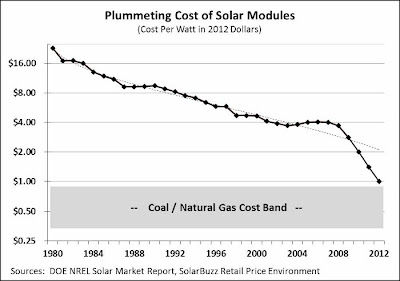
However, this chart is already outdated. According to recent market research, we are now at $0.50 per watt for solar cells instead of $1.00 per watt, and we're heading for $0.36 per watt by 2017. After that solar will be cheaper than coal or natural gas are today. In the mean time, those fossil fuels are getting more expensive as they get harder to recover in more remote reserves and as the quality of those resources diminishes because we're using up the highest quality reserves first.
If all of these solar panels were installed as massive projects sponsored by the government and power utility companies, it would truly be a huge undertaking, similar to the U.S. interstate highway system. But if the installation was widely distributed, it would be much more like the formation and growth of the internet, and the main issue would be the manufacturing of huge quantities of solar panels. So how could we make significant progress in covering 13,200 square km of space with solar panels?
Rooftop installations on residential, commercial, and industrial buildings: Once solar panels are cheap enough that their break-even point with traditional electricity is 3-5 years or less, every individual consumer and business is going to have a huge incentive to convert to solar. If the panels are financed, consumers and businesses will be able to reduce their monthly energy costs immediately, and then they'll have substantially reduced energy costs once the panels are paid off.
Solar canopies in parking lots: There are huge areas of parking lots across America that could be partially covered with solar panels. Businesses could have that electricity available for their employees and customers to charge electric cars, or sell the surplus electricity to utility companies.
Solar panels on cars: I brought up the idea of adding solar panels to electric cars as a way to extend the range of the car's battery, but for everyday driving they would serve equally well for charging the battery without ever having to plug it in. On a typical day I drive less than 25 miles to and from work, and my car sits in the sun for the entire day. If I could have 5 square meters of 20% efficient solar panels on my car, they would nearly replenish the battery everyday. More efficiency directly translates into more miles per day. Considering that the average American drives less than 40 miles a day, this is a significant amount of driving sourced directly from the sun, and if the battery didn't need the extra charge, the car could be plugged in so that the elecricity went back to the grid.
Solar panels on semi-trailers, buses and trains: There are 5.6 million semi-trailers registered in the U.S. with a typical roof surface area of 100 square meters. That's 560 square km of area being hauled around the country by trucks. If they were fitted with solar panels on top and a decent sized battery underneath, the extra energy could supplement hybrid semi-truck engines to increase their efficiency. Similar logic could be extended to buses and trains.
Wind turbines: As long as wind turbines stay competitive with solar panels, wind farms and consumer wind turbines can carry a lot of the necessary energy load. They're also a good compliment to solar because in a lot of places and at many times when the sun isn't shining, the wind is blowing.
Traditional power plant sized installations: There will still be a significant need for large-scale installations of solar power plants and wind farms because not everyone has the space or the desire to have their own solar panels or wind turbines.
Once a significant portion of the population is generating their own power, and they're connected through the grid, things will start to get very interesting. When enough people were connected through computers and the internet and barriers to self-publishing content came crashing down, things changed in completely unpredictable ways. People did not foresee the development of Wikipedia, Facebook, and Twitter and what they would do to serve as platforms for individual, freely-shared content creation.
Prior to the internet, content creation was primarily controlled and distributed by publishing and broadcasting companies. Individuals only had access to public exposure through these companies. Media was centralized in a way very similar to how electricity and oil companies are now. Individuals depend on getting their energy from these sources, but what will happen when that changes? The role of utility companies will surely change.
Those companies that cannot adapt will get left behind, like encyclopedia producers and some newspapers did when the internet changed the rules for communication. If utility companies are to survive, they'll have to figure out how to make more of a business of metering and managing power from its widely distributed sources and less from generating it themselves. Once people are both producers and consumers of energy, there will be much more of a need to keep tabs on their net energy usage. Some people will be net producers and others will be net consumers, and energy will be shared within a much more interconnected network. I'm not sure what the oil companies will do.
It is really difficult to predict what will happen when people producing their own energy is the norm. All I can think of is that energy will be cheaper and the friction inherent in the current centralized system will be eliminated. When that happened to the telecommunications industry, we saw drastic changes in our society. And every time we capture a cheaper and more abundant source of energy, like coal in the Industrial Revolution or petroleum in the Technical Revolution, we also see drastic changes in our society. We are still in the midst of the Digital Revolution, and we are likely about to see both a reduction in the cost of energy and a change from centralized to distributed energy. I honestly can't imagine what is going to happen because of that, but I can say one thing. It's going to be big.
Now we are in the midst of The Digital Revolution where the widespread use of computers and the internet are continuously changing how we interact with other people. Yet, we haven't seen a major disruption in how we produce and use energy in a way similar to that characterized by the last two technological revolutions. That change is surely set to come, and the way that the internet has changed our relationship with each other could show the way that our relationship with energy will change.
First, a Disclaimer
It seems that some people thought from my last article that I was portraying myself as an expert in the future of EVs. Let me be completely clear that I am not an expert in that, nor in this article on the future of energy. My expertise comes solely from what I read about the subject, and my desire to wrestle with complex ideas and combine trends together to speculate about the future. If at any point it seems like I don't know what I'm talking about, that's because I don't, but quite possibly, neither do you. The future of technology is notoriously hard to predict, yet it is still great fun to do, so I like to keep an open mind.
In speculating about future technology, I try to look at general trends without looking specifically at what is possible today. Doing that may carry me past the edge of possibility, but that is where real disruptive advances in technology happen. The naysayers are always right at first, but they are only right until someone who's likely not paying attention comes along and proves them wrong. That's when the impossible becomes possible. So, here's fair warning that there is hand-waving optimism ahead. If that offends you, stop reading now, but if you enjoy dreaming about eternal possibilities, then let's have some fun.
Oil and Coal vs. Solar
The amount of solar energy that hits the Earth's surface is simply astounding. Let's do some quick and dirty calculations to get an idea of how much energy we're talking about here. Since these will be incredibly large numbers, we'll use petawatt-hours (PWh) as the energy unit of measure. That's a watt-hour with 15 zeros behind it.
We can approximate the surface of the Earth as a disc that the sun's rays hit. The area of that disc multiplied by the solar constant of 1,366 watts per square meter gives the amount of solar radiation that hits the Earth's surface in an instant. The radius of the Earth is about 6,371 km, giving a disc area of 127.5 * 10^12 square meters and an energy flux of 174 PW. Multiply this by 24 hours to get the amount of solar energy reaching Earth's surface in a day - about 4,180 PWh.
As a point of comparison, the total energy used by commercial energy sources from 1880 to 2000 is about 4,806 PWh. Let that sink in for a moment. The Earth is bathed in nearly as much energy from the sun in one day as the world used in 120 years. We might want to think about capturing some of that energy. Of course, we can't capture anywhere near all of that solar energy. Much of it is absorbed by the oceans, plants need it for photosynthesis, and the Earth needs a fair amount for warmth to support life. But the World's energy usage in 2010 was about 150 PWh, or about 0.41 PWh per day. That's rounding error compared to the amount of solar energy we're getting in a day.
If we were to capture some of this energy using solar PV panels, it's difficult to think about how much we could reasonably capture starting from all that is available, so let's come at it from the other direction of how much we need to satisfy our energy needs. Limiting things a bit further, let's look at the energy needs of the U.S. Here is a great chart of the U.S. energy usage in 2012, from Lawrence Livermore National Labs (click to enlarge):

For our purposes, we'll convert Quads to PWh, with 1 Quad equaling 0.293 PWh. That means the U.S. used 27.9 PWh of energy in 2012, mostly coming from natural gas, coal, and petroleum. But look at how much was wasted in electricity generation and transportation. Electricity generation was only 32.5% efficient and transportation was abysmal at 21% efficient. Most of that energy was expelled as heat, as well as a significant amount of wasted electricity because utilities need to generate extra supply for demand spikes.
Solar (and wind) is inherently different than fossil fuels because the energy is there regardless of whether we use it or not. Any amount of energy we can capture for useful purposes can be thought of as energy that was reclaimed from the vast amount of unused renewable energy that's available. And once solar power plants are installed, the maintenance and operating costs can be much lower than coal power plants or oil refineries because the energy source does not need to be constantly dug out of the ground and consumed by the plant; it's already freely available without any extra effort to keep generating electricity.
Because of the way that residential, commercial, and industrial sectors use electricity that already uses raw resources, as well as their relatively high efficiency compared to generation and transportation, let's ignore them and focus on the amount of energy consumed from electricity generation and transportation that does useful work. If we were to replace all of that coal and oil (and natural gas, nuclear, etc) with solar energy, we would need to generate 5.27 PWh of energy per year.
How much solar panel area would that require? From the National Renewable Energy Lab, we can estimate that on average the U.S. receives about 5.5 kWh per square meter per day, or 2.0 MWh per square meter per year, of solar energy. Solar panels are far from perfect, though. If we assume they are 20% efficient at converting solar radiation into electricity, we would need 13,200 square km of solar panels to supply the U.S. electricity and transportation needs. That's about 110 square meters, or 1,180 square feet, of solar panels for every U.S. household. It's a lot, but still doable.
On a side note, that 20% efficiency estimate is likely on the low side for the future, considering the continuous advances made in solar cell efficiency as shown in this chart from the NREL:

On the other hand, assuming that all of our transportation needs will be supplied with electricity is highly unlikely. I do believe that the energy market for transportation will become much more segmented with biofuels, hydrogen fuel cells, and electricity all competing with gas and diesel in the transportation sector for quite a long time. The point of combining our electricity and transportation needs together is to get a rough idea of what it would take to transition most of our fossil fuel use to a more sustainable form of energy.
Where to Put All of Those Panels?
If we have learned anything from the internet, it is that distributed, networked solutions can be extremely powerful. What happens if we bring some of that knowledge to our energy problem? For the first time in modern history the prospect of the average person having their own personal power plant is within reach. The cost per watt for solar cells is dropping like a rock and quickly reaching or even surpassing the cost for coal or natural gas generated electricity, as shown in the following chart from the DoE:

However, this chart is already outdated. According to recent market research, we are now at $0.50 per watt for solar cells instead of $1.00 per watt, and we're heading for $0.36 per watt by 2017. After that solar will be cheaper than coal or natural gas are today. In the mean time, those fossil fuels are getting more expensive as they get harder to recover in more remote reserves and as the quality of those resources diminishes because we're using up the highest quality reserves first.
If all of these solar panels were installed as massive projects sponsored by the government and power utility companies, it would truly be a huge undertaking, similar to the U.S. interstate highway system. But if the installation was widely distributed, it would be much more like the formation and growth of the internet, and the main issue would be the manufacturing of huge quantities of solar panels. So how could we make significant progress in covering 13,200 square km of space with solar panels?
Rooftop installations on residential, commercial, and industrial buildings: Once solar panels are cheap enough that their break-even point with traditional electricity is 3-5 years or less, every individual consumer and business is going to have a huge incentive to convert to solar. If the panels are financed, consumers and businesses will be able to reduce their monthly energy costs immediately, and then they'll have substantially reduced energy costs once the panels are paid off.
Solar canopies in parking lots: There are huge areas of parking lots across America that could be partially covered with solar panels. Businesses could have that electricity available for their employees and customers to charge electric cars, or sell the surplus electricity to utility companies.
Solar panels on cars: I brought up the idea of adding solar panels to electric cars as a way to extend the range of the car's battery, but for everyday driving they would serve equally well for charging the battery without ever having to plug it in. On a typical day I drive less than 25 miles to and from work, and my car sits in the sun for the entire day. If I could have 5 square meters of 20% efficient solar panels on my car, they would nearly replenish the battery everyday. More efficiency directly translates into more miles per day. Considering that the average American drives less than 40 miles a day, this is a significant amount of driving sourced directly from the sun, and if the battery didn't need the extra charge, the car could be plugged in so that the elecricity went back to the grid.
Solar panels on semi-trailers, buses and trains: There are 5.6 million semi-trailers registered in the U.S. with a typical roof surface area of 100 square meters. That's 560 square km of area being hauled around the country by trucks. If they were fitted with solar panels on top and a decent sized battery underneath, the extra energy could supplement hybrid semi-truck engines to increase their efficiency. Similar logic could be extended to buses and trains.
Wind turbines: As long as wind turbines stay competitive with solar panels, wind farms and consumer wind turbines can carry a lot of the necessary energy load. They're also a good compliment to solar because in a lot of places and at many times when the sun isn't shining, the wind is blowing.
Traditional power plant sized installations: There will still be a significant need for large-scale installations of solar power plants and wind farms because not everyone has the space or the desire to have their own solar panels or wind turbines.
Distributed Energy Generation Will Change Everything
Once a significant portion of the population is generating their own power, and they're connected through the grid, things will start to get very interesting. When enough people were connected through computers and the internet and barriers to self-publishing content came crashing down, things changed in completely unpredictable ways. People did not foresee the development of Wikipedia, Facebook, and Twitter and what they would do to serve as platforms for individual, freely-shared content creation.
Prior to the internet, content creation was primarily controlled and distributed by publishing and broadcasting companies. Individuals only had access to public exposure through these companies. Media was centralized in a way very similar to how electricity and oil companies are now. Individuals depend on getting their energy from these sources, but what will happen when that changes? The role of utility companies will surely change.
Those companies that cannot adapt will get left behind, like encyclopedia producers and some newspapers did when the internet changed the rules for communication. If utility companies are to survive, they'll have to figure out how to make more of a business of metering and managing power from its widely distributed sources and less from generating it themselves. Once people are both producers and consumers of energy, there will be much more of a need to keep tabs on their net energy usage. Some people will be net producers and others will be net consumers, and energy will be shared within a much more interconnected network. I'm not sure what the oil companies will do.
It is really difficult to predict what will happen when people producing their own energy is the norm. All I can think of is that energy will be cheaper and the friction inherent in the current centralized system will be eliminated. When that happened to the telecommunications industry, we saw drastic changes in our society. And every time we capture a cheaper and more abundant source of energy, like coal in the Industrial Revolution or petroleum in the Technical Revolution, we also see drastic changes in our society. We are still in the midst of the Digital Revolution, and we are likely about to see both a reduction in the cost of energy and a change from centralized to distributed energy. I honestly can't imagine what is going to happen because of that, but I can say one thing. It's going to be big.
An EV Future is Inevitable

In the near future EVs (electric vehicles) will increasingly replace ICE (internal combustion engine) vehicles as our primary form of transportation, and that pace is going to accelerate. I am convinced that this is inevitable for three main reasons: the economics of EVs, the pace of innovation in EVs, and the ERoEI (Energy Returned on Energy Invested) of solar and wind vs. oil.
At this point it is very unlikely that any other technology under development has the potential to replace EVs as the way we're going to get around in the future. Any other technology would not only have to beat ICE cars on price, performance, and efficiency, but it would have to overcome the large and growing gains that EVs are already making in these areas.
Soon EVs Will Cost Less Than ICE Vehicles - Outright
This year GM dropped the price of the Chevy Volt by $5,000. Nissan dropped the price of their Leaf models by $2,500-$3,500 and introduced a new economy model starting at only $28,800. That's before the $7,500 federal rebate. Some states offer substantial tax credits on top of that, and now that the Leaf is more widely available, you can easily walk out of a dealership with a Leaf S for $20,000 or less. Compare that to a similarly equipped Toyota Prius II with an invoice price of $23,700, and you can see the edge that the Leaf is quickly developing against other cars even before fuel costs are tallied.
You can still get a Corolla, Civic, or similar car for less than a Leaf S, but for how long? In only two years the Leaf's price has dropped substantially, and other EVs are following suit. The Chevy Spark EV is starting at $27,500 and the BMW i3 is starting at $28,500 - both before incentives and credits and way sportier to drive than a Corolla or a Civic. The reason for these low and falling prices is likely the comparatively simple design. EVs are pretty much a battery driving a motor with a charger tacked on. Certainly, there are sophisticated electronics in the mix, but every modern car has a healthy dose of electronics. The electronics in EVs just serve a different function. Instead of controlling fuel injection and valve timing, it's managing a battery and a motor. The battery is where most of the cost is currently, but we are already seeing that drop as economies of scale start having an effect. There is a lot of room in EV production to wring out cost inefficiencies, whereas with ICE cars, most of those price reductions are long gone.
When more than half the price of an EV is in the battery, and the battery price has plenty of room to fall, ICE cars are going to find it tough enough to compete. But then you have to pay at the pump, too. According to the EPA at fueleconomy.gov, the average annual fuel cost of a typical 2013 vehicle with 23 MPG driven 15,000 miles per year is $2,350. For a car that averages 30 MPG, such as a Toyota Corolla, that comes down to $1,850 per year. For a Prius with 50 MPG, you can get down to $1,100 per year. The Leaf blows them all away with an average charging cost, according to the EPA, of $500 per year!
That means the Leaf can cost over $100 less per month to drive than a typical economy car, and remember that there's essentially zero maintenance on it as well. With gasoline prices more than likely to continue going up in the future, and battery costs going down, ICE cars will only get more expensive as EVs get cheaper. The idea should not be that EV prices will eventually converge with ICE prices. Instead, we are quickly reaching a crossover point where prices between the two diverge with EVs handily beating ICE cars on price as well as comfort and performance. The Leaf S can arguably already claim that position, and a real tipping point is not far off.
EVs Are at the Point Computers Were in the Early 1980s
EVs have a couple of major drawbacks that currently stop most people from considering them as their primary car: charging time and range. To that I say, EVs are in the early stages of a new technology wave similar to where computers and the internet were in the early 1980s. Think about how fast computer technology advanced in the 80s and 90s. They were slow and clunky and couldn't do much by today's standards, but their performance and capabilities were doubling every 18-24 months, courtesy of Moore's Law.
Batteries don't have a similar doubling law, but the amount of effort going into increasing their capacity will likely yield major improvements in the next decade. Technologies like lithium-air and sodium-air batteries and super capacitors show good promise, and the range really only has to double twice from the Leaf's 75 miles before it's comparable to a typical ICE car. That could easily happen in the next 6-10 years while battery prices hold at their current price or continue to drop. One more doubling past that, and EVs really start to make ICE cars look irrelevant.
Charging will become a non-issue even more quickly. Nissan already cut their charge times in half at Level 2 charging stations - from 8 hours for the 2011-2012 Leafs to 4 hours for the 2013 Leaf - with a 6.6 kW on-board charger. Other manufacturers have similar charge times, and there's also the Level 3 quick chargers that can charge a battery to 80% in 25 minutes. One thing is clear; EVs are advancing at a rate that is repeatedly making last year's models obsolete, similar to what was happening to computers over the last few decades.
If the EV of the near future has a 300-mile range and can be charged in 4 hours or less (the Tesla Model S is already there, but at 2-4 times the price of other EVs), the only real place that ICE cars still hold an advantage is with long road trips. If you want to drive 600 miles in a day, even an EV with a 300-mile range could be inconvenient. I think it would still be quite doable if the charging infrastructure was in place so that when you stop every hour or so to stretch your legs you can charge for 25 minutes. That would extend the range enough to go the whole day, and then you would charge overnight to start again the next day with a full battery.
I think there's a better solution, though. Most of that driving time will be spent under the sun, and solar panels are improving rapidly. What better way to extend the range than to slap some high efficiency panels on the car's roof and drive all day long? I'm sure that solar panels will reach the point where it would be possible to have an EV with infinite range as long as the sun is out, and on cloudy days you could fall back to plug-in charging or maybe inductive charging. If and when solar panels get good enough, they could provide the electric power for the motor directly to save some charging and discharging of the battery. Any extra power generated when the motor doesn't need it - either when coasting, stopped, or parked - could be stored in the battery for later. If you think about how often cars are just sitting outside parked in the sun, solar panels would be a huge win.
Clearly EVs are still in their infancy, and they are developing quickly. In 2011 the Leaf was the first EV intended for mass market sale to private consumers. The Chevy Volt was the first PHEV (plug-in hybrid electric vehicle) that same year. Now there are over a dozen EVs and PHEVs to choose from, and more are being announced every month. Nissan alone plans to produce 5 EV models. It won't be long before consumers will have EV options in every size class of car. The current state of EVs and the rate of innovation is truly reminiscent of the early days of personal computing, and in 30 years we will be as amazed at how much the automotive industry has changed as we are now with the telecommunications industry.
There is More Sunshine Than Oil
We have developed a massive infrastructure built on oil over the last 100 years that has enabled tremendous economic growth, but also a short-sighted dependence on a limited natural resource. Our transportation infrastructure is especially dependent on oil, and it is becoming clearer by the day that the amount of oil left in the ground is likely less than what we've already pulled out and is increasingly hard to get at. That means that every barrel of oil we suck out of field reserves costs more than the last one. That is why shale oil and tar sands are now economically viable oil fields to develop. If crude oil was still $40/barrel, those unconventional oil sources would be economically off-limits, but at $110/barrel they're profitable.
But stop and think about what crude oil really is. It is a concentrated and stored form of sunlight. Over millions of years, plants converted the sun's rays into organic material and animals fed on those plants, creating more organic material. All of that organic material died, decomposed and made its way into the oil reserves that we are now drilling and pumping out of the ground. The process takes so long and is so indirect that these reserves are a one-time deal. We are expending an enormous amount of effort digging sunlight out of the ground, and all the while it is shining us right in the face. There are much more immediate forms of energy that we can harvest more directly from the sun, and we already are doing so in limited quantities.
Growing crops that can be used to produce ethanol is one more direct method. It cuts out the time needed to decompose, concentrate, and store the sun's energy in the form of oil. However, the process of making ethanol takes more energy, produces a fuel with less energy content, and uses land that could be used to grow food instead. Hydroelectric dams and wind turbines are even more direct ways to generate usable energy from the sun through the water cycle and air currents, respectively. Both of these mechanisms are byproducts of the sun's rays shining through our atmosphere.
The most direct way we can convert sunlight into energy is by using solar PV (photovoltaic) panels to generate electricity. New concentrated PV panel arrays can be over 80 times more efficient than ethanol produced from sugar cane when comparing energy generation per acre of land. Even a new advance process of ethanol production that cultivates a form of algae that actually sweats the stuff is less than 1/5th as efficient as these CPV panels, and more electronics advances are coming down the pipeline to make CPV even more efficient.
If you look at the amount of energy returned on energy invested for each of these energy sources, and even more important, the trajectory of each of them, it becomes painfully obvious that oil is on its way out and solar and wind are on their way in.
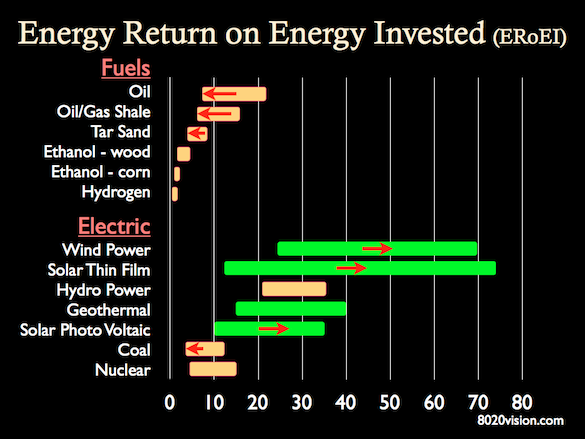
While various forms of oil are becoming less ERoEI efficient, solar and wind power are becoming more efficient, and the amount of potential in these new renewable energy technologies is incredible. That means gasoline can only get more expensive in the future. It may stay even with its current prices as more people make the switch to renewable power, reducing the pressure on oil demand, but it can't get cheaper because there is a large and growing cost to extraction. Oil companies are not going to sell for less than it costs them to deliver the oil to market. Electricity generation is already one third to one quarter of the cost per mile as a vehicles power source, and solar and wind power will only make those costs drop further as more efficient renewable power plants come online. They are going to not only be able to replace oil as a source of energy, but also drive economic growth for the foreseeable future.
Solar and wind power are also a great match for EVs for three main reasons. First, they can generate the car's fuel directly with much greater efficiency. Oil production has efficiency losses every step of the way from drilling and extraction of harder to reach reserves, transportation of crude oil, the refining process, transportation of gasoline, and finally burning the fuel in an engine that's 25-30% efficient. In contrast, an EV hooked up to solar panels is directly converting solar energy to electric energy and dumping it in a battery that powers an electric motor that can be over 95% efficient. There are some losses going into and out of the battery, but they are nothing compared to the losses involved in the ICE car supply line.
Second, the extra storage capacity in EV batteries can smooth out the sporadic nature of renewable energy sources. Imagine if we had millions of EVs in the US with batteries that could collectively store hundreds of Gigawatt-hours of energy. This amount of extra storage in the grid would smooth out most of the intermittent supply problems of solar and wind power, and with most cars being charged at night, they would also help regulate total energy consumption during off-peak hours for hydroelectric and wind power so that it doesn't go to waste.
Finally, once EVs have enough range, consumers could reserve a portion of their battery power to source back to the grid during peak energy usage hours, but that may not even be necessary. As batteries get retired from service in vehicles, power companies are already planning to use them for extra storage, neatly solving the battery recycling issue. This could also be done on a smaller scale by individuals. My Leaf's 24 kWh battery is almost enough to cover my home's electricity needs for an entire day. If I could convert it to be used for storage for solar panels or a wind turbine, I could go completely off the grid and still be able to weather temporary power generation shortages from cloudy or calm days. My home would become a self-sufficient power plant. The combination of renewable energy and EVs gives people the possibility of true personal energy independence for the first time since the industrial revolution started.
The Future is Now
EVs are the future of transportation, and as their prices drop, battery technology improves, and renewable energy advances, it will become undeniable. Right now there are a lot of people who refuse to believe that EVs will actually succeed or actively want to see them fail. I can only say that these people are on the wrong side of history. Don't underestimate the power of technological progress. In thirty years those naysayers are going to look like the people that thought the internet was a fad. EVs are a big part of the next technology wave that's currently building strength. Are you ready to ride that wave, or are you going to let it wash right over you?
The Rest of the Leaf Series:
Part 1: The Acquisition
Part 2: The Summer Drive
Part 3: The Winter Drive
Part 4: Frills and Maintenance
Part 5: The Data
Part 6: The Future
Part 7: The Energy Efficiency Meter
Subscribe to:
Posts (Atom)